How to Qualify a Website Lead in Three Chat Questions
November 11, 2026

Most website visitors are not ready to buy. Some are researching, some are comparing prices, and some are simply lost. If your team treats every chat as a sales call, you spend hours on conversations that go nowhere. A short qualifying sequence fixes that. In our experience, three questions cover most of what you need to know before handing a lead to a person.
The goal is not to interrogate the visitor. It is to make a fast, honest judgement about whether this is a good fit, and to route them to the right next step. Here is a practical way to do it.
Question 1: What do you need help with?
Start with the problem, not the budget. A specific answer tells you whether you actually offer what they want. “I need a new website” is a clear signal. “Just looking around” is not, and the agent should respond to that gently and offer a useful resource rather than pushing a meeting.
Ask it in plain words, and keep the list of services you offer in front of the agent so it can match the answer quickly. If the visitor asks for something you do not provide, say so directly. Sending someone away early is better than promising work you cannot deliver.
Question 2: When are you hoping to get started?
Timing separates urgent needs from future ones. Someone who needs help this month is a different lead from someone who is planning for next year. Neither is wrong, but they call for different follow-up. A near-term lead can be offered a meeting slot today. A later one can be added to a nudge sequence or sent a relevant guide.
Give the visitor easy options so the question feels like a convenience rather than a test. For example: “This month,” “in the next few months,” or “just exploring.”
Question 3: Roughly what budget have you set aside?
Budget is the question most people dislike, so ask it last, after you have shown you can help. Most visitors will give a range if the question is framed as a way to point them to the right option. Offer bands rather than an open box, such as “under 2,000,” “2,000 to 10,000,” or “over 10,000.” Do not force an answer. A visitor who skips it can still be booked if the first two answers are strong.
Be honest about what your bands mean. If your smallest engagement starts at a certain price, the agent should not suggest otherwise.
A short example
This is a hypothetical conversation for a small web design studio:
- Visitor: Hi, I need a new site for my bakery.
- Agent: Happy to help. Is this a new site from scratch, or a redesign of an existing one?
- Visitor: Redesign. I’d like it done in the next month or so.
- Agent: Good timing. Roughly what range have you set aside: under 2,000, 2,000 to 10,000, or over 10,000?
- Visitor: Probably around 3,000.
- Agent: That fits our redesign packages. Would you like to book a 20-minute call with the team this week?
In this case the agent asked three questions, got a clear need, a near deadline and a workable budget, and moved straight to booking. Your flow will differ, but the structure holds.
What to do with the answers
Decide in advance what counts as a qualified lead. A simple rule works: a clear need you serve, a timeframe within a few months, and a budget within your range. Leads that meet all three go straight to a booking. Leads that meet one or two get a follow-up. Leads that meet none get a helpful resource and a polite close. Review the results every few weeks and adjust the wording if too many good prospects are slipping through.
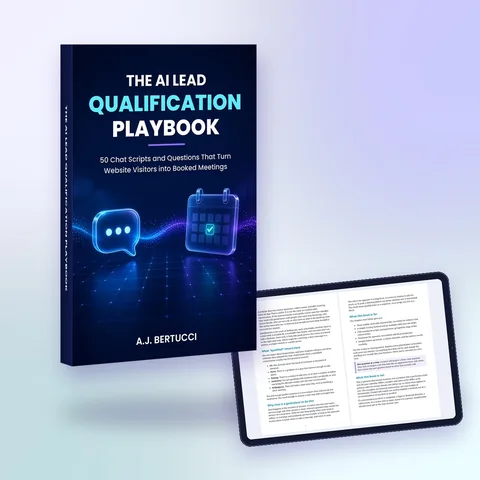
If you want the full set of scripts, routing rules and objection replies we use, the free playbook at https://aileadsagent.com/ebook/ covers them step by step.
When you are ready to put this into your own chat, compare the options at https://aileadsagent.com/plans/.
This article was written with the help of AI.